Total Pageviews

Friday, December 30, 2016

Strengths-based Practice in Education

Adopting a strengths-based perspective of education is a perspective that I feel very strongly about.  In education, I want to work with families to get the best overall help and care that they need for their family.  According to Pattoni, (2012) “strengths-based practice is a collaborative process between the person supported by services and those supporting them, allowing them to work together to determine an outcome that draws on the person's strengths and assets (p.4). The standards of practice are:
1.    Goal orientation: Strengths-based practice is goal oriented. The central and most crucial element of any approach is the extent to which people themselves set goals they would like to achieve in their lives.
2.    Strengths assessment: The primary focus is not on problems or deficits, and the individual is supported to recognize the inherent resources they have at their disposal which they can use to counteract any difficulty or condition.
3.    Resources from the environment: Strengths proponents believe that in every environment there are individuals, associations, groups and institutions who have something to give, that others may find useful, and that it may be the practitioner's role to enable links to these resources.
4.    Explicit methods are used for identifying client and environmental strengths for goal attainment: These methods will be different for each of the strengths-based approaches. For example, in solution-focused therapy clients will be assisted to set goals before the identification of strengths, whilst in strengths-based case management, individuals will go through a specific 'strengths assessment'.
5.    The relationship is hope-inducing: A strengths-based approach aims to increase the hopefulness of the client. Further, hope can be realized through strengthened relationships with people, communities and culture.
6.    Meaningful choice: Strengths proponents highlight a collaborative stance where people are experts in their own lives and the practitioner's role is to increase and explain choices and encourage people to make their own decisions and informed choices. (Pattoni, 2012, p.5)
As an early childhood educator, I want to be an advocate of strengths-based approaches to learning with my students and their families.  The literature, as stated in Pattoni’s work (2012), states that, “personal strengths are associated with academic success, self-determination, and life success” (p.10). I want everyone involved to benefit.  I want parents to feel successful when they get the help that is needed and feel like they are capable parents.  I also want my students to reach their full potential. 
Strengths-based practice is important to me because I have had to deal with different networks in the past to get adequate food, clothing, shelter, and mental care for families.  When a person doesn’t have anywhere to go, they have no idea who to turn to.  I had to reach out and help in any way possible.  I wanted what was best for my student and his family.  I reached out to the Department of Family and Children Services, the Housing Authority, the local Food Bank, and the Mental Health Agency getting the materials that the mother needed in order to be a successful parent.  The network of people involved were very helpful, and the mother was grateful and appreciative.  The students school success changed dramatically after everything was in place.  It was extremely rewarding!
Questions of calls for support from colleagues:
·        What agencies would you call on?
·        Do you think strengths-based practice is appropriate?
·        How would you help families? To what extent?


References
Pattoni, L. (2012). Strengths-based approaches for working with individuals. Retrieved from https://www.iriss.org.uk/sites/default/files/iriss-insight-16.pdf


Tuesday, December 13, 2016

We had a visit today from the firefighters.  They taught us how to be safe if there was ever a fire. We know to Dial 911 and Stop, Drop, and Roll. They brought us all a goody bag with tips about fire safety. We also got to see what the fire truck is all about. Oh my! Those sirens were real loud!!

Monday, December 12, 2016

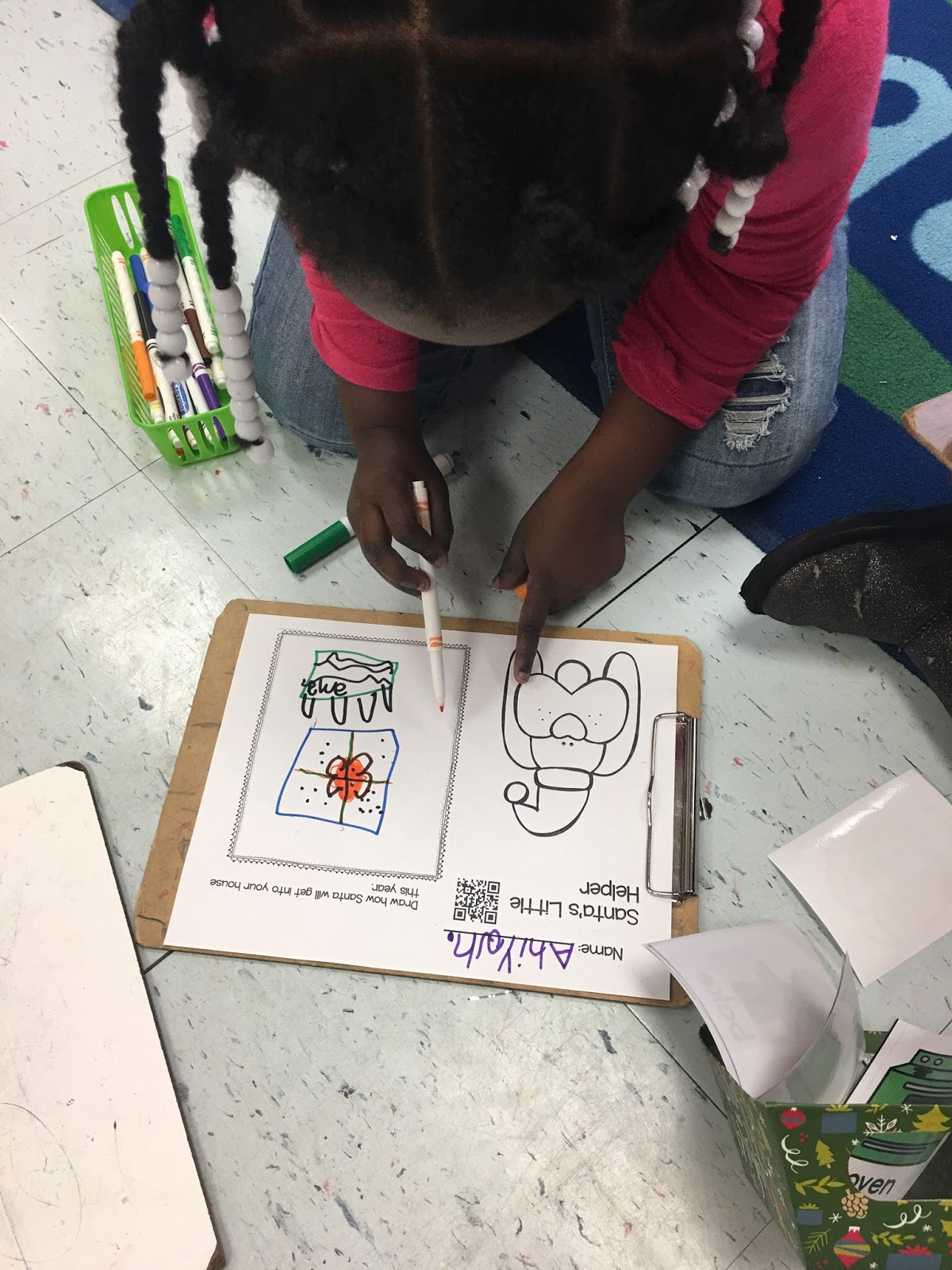
Christmas!!!

The decorations are hung in the classroom with cheer, when the children come back it will be a new year. . . 
We've decorated gingerbread men, reindeer, and stained glass ornaments. . . 


Emergent readers & Stamp It from Mrs. Wills Kindergarten 


Breakfast with Santa!

We ended last week with a visit to have Breakfast with Santa! The kiddos were so excited to tell them their Christmas wishes.  Our Santa cam is constantly sending pictures to the North Pole to show Santa our smart choices! We can hardly wait for his arrival on Christmas Eve...


Thursday, December 8, 2016

The attitude of the teacher should be at once positive, scientific and spiritual. Positive and scientific, because she has an exact task to perform, and it is necessary that she should put herself into immediate relation with the truth by means of rigorous observation.
—Dr. Maria Montessori, educator and theorist (Montessori, 2009, p. 155)


Decorating the Christmas Tree!! So exciting!!


Important Figures in Education

Historical Figure in Education- Jean-Jacques-Rousseau
  • Born in Geneva in 1712 and lived until 1778.  
  • Figure in the history of philosophy because of his thinking in moral and political psychology.  
  • Explored two ways to achieving and protecting freedom: the first is a political one aimed at constructing political institutions that allow co-existence of freedom and the second one is a project for child development and education that fosters autonomy and avoids the development of the most destructive forms of self-interest. 
  • Contributed to the theory of music and he was a composer, novelist, and botanist.  
  • Interests in nature and feelings made him the philosopher that he is known for today.  
  • Believed that children should be encouraged to develop their own strengths in an unrestricted environment.  
  • Contributed to readiness, social and emotional development, and a belief that a child should be the center of curriculum and be responsible for their learning path.  
I believe that his contributions were significant to education because the development of a child is so important and we should not require them to complete tasks that they are not ready for.  We should let children be children and give them fun learning tasks so that they are happy and engaged.  His work has definitely impacted what I do every day.  I use developmentally appropriate practices in my classroom and I still involve play and let my children be children.  I believed that “children should be happy and their development should occur over time.” (Laureate, 2015)  
They are engaged and learning all while completing activities and playing in centers.  
Contemporary Figure in Education- Sir Ken Robinson
  • A visionary and cultural leader who led the British government's 1998 advisory committee on creative and cultural education.  
  • Works with governments, education systems, international agencies, global corporations and some of the world’s leading cultural organizations. 
  • Professor at University of Warwick for twelve years. 
  • In 1999, he led a national commission on creativity, education and the economy of the UK Government.  
  • Named a Time/Fortune/CNN Principal Voice
  • Wrote top selling books about his passion- A 10th anniversary edition of his classic work on creativity and innovation, Out of Our Minds: Learning to be Creative, was published in 2011. His 2013 book, Finding Your Element: How to Discover Your Talents and Passions and Transform Your Life, is a practical guide that answers questions about finding your personal element. “In his latest book, Creative Schools: The Grassroots Revolution That’s Transforming Education, he argues for an end to our outmoded industrial educational system and proposes a highly personalized, organic approach that draws on today’s unprecedented technological and professional resources to engage all students.” (Robinson, 2016)  
  • Conducts TED Talks and one that he is the most famous for is about educating children away from being creative and critical thinkers.  We are teaching them so rigorously that they don’t have room to use their little minds and be creative.  
I feel like his contributions make a great impact on education today because he speaks out about how children need the opportunity to be creative and use their brains to think and be problem solvers.  Instead of expecting a certain way for a child to complete a task, we should be open to letting them “solve” or “create” the masterpiece. He has impacted my teaching because I provide ways for problem and creativeness every day in my kindergarten classroom.  I want my students to be engaged in such activities.  “Sir Ken Robinson champions a radical rethink of our school systems, to cultivate creativity and acknowledge multiple types of intelligence.” (Robinson, 2016)
References
About me.  (n.d.). Retrieved December 07, 2016, from http://sirkenrobinson.com/about
Bertram, C. (2010, September 27). Jean Jacques Rousseau. Retrieved December 07, 2016, from https://plato.stanford.edu/entries/rousseau
Laureate Education (Producer). (2015). Sectors in the early childhood field [Interactive media].Baltimore, MD: Author 
Robinson, K. (n.d.). Ken Robinson. Retrieved December 07, 2016, from https://www.ted.com/speakers/sir_ken_robinson


Tuesday, December 6, 2016

Christmas Fun!!

Christmas Counting 
Gingerbread Problem Solving

Freebie on TPT- check it out! 


Check out Poetry Stations from DeeDee Wills. I love incorporating her poetry in my classroom! 
Christmas Tree Playdough Fun! From: prekinders.com 
Decorating our pretty Christmas Trees
  

Playdough/Cookie Cutter Station


HO HO HO!!! Checkut my pin below on Pinterest for these crafts!